Personal machines. Open possibilities.
Rydell Robotics is an independent development initiative focused on accessible personal robotics, local artificial intelligence, and open, adaptable robotic systems.
Robotics for ordinary people.
Robots should be personal, understandable, repairable, customizable, and accessible to ordinary people. That philosophy shapes our approach to both intelligence and hardware.
The expressive utility droids of science fiction and the engineering of real planetary rovers offer inspiration—not evidence of capabilities already achieved. Our long-term ambition is an ecosystem of companions, rovers, and supporting technologies grounded in practical experimentation.
We are at the beginning of that work. Rydell Robotics is not advertising finished machines; this is the public home of an early research and development effort.
A practical foundation.
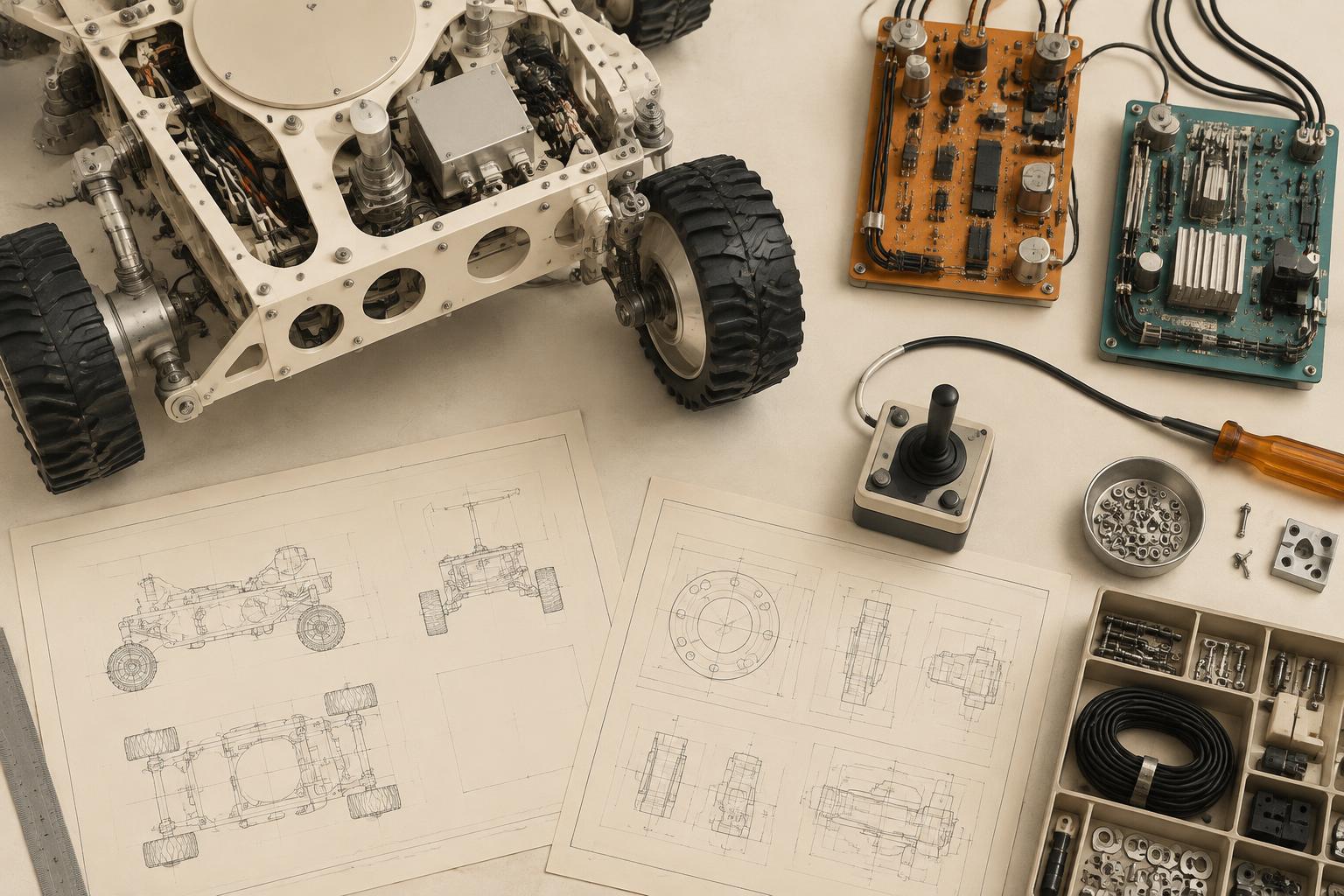
Investigate resource-conscious software and affordable computing hardware. Accessible robotics begins with systems people can understand and work with.
Built to be understood.
Favor modular, replaceable components and open, adaptable systems. Repair and customization are architectural goals, not afterthoughts.
Ambition without pretense.
Distinguish intended designs from demonstrated results. Models, features, and platforms require evaluation before we can claim they work.
Embrace Artificial Intelligence Without Embracing Artificial Humanity.
Robots should be robots.
Artificial intelligence offers extraordinary possibilities for companionship, assistance, exploration, and creativity. We intend to pursue them. But building machines that are more intelligent does not require building machines that are more human.
We do not accept the assumption that the highest achievement of robotics is a machine that looks, speaks, moves, and behaves indistinguishably from a person. Human-shaped robots can be genuinely useful — for tools, shared workspaces, and research into movement and interaction — and we expect to learn from that work. It is simply not our preferred path to companionship.
A humanoid form often adds mechanical complexity, cost, and maintenance burden while narrowing what a small personal machine can realistically do. It can also produce an uncanny effect: the closer a machine comes to imitating a person, the more likely the resemblance is to create discomfort rather than connection.
Our deeper reason is philosophical. When a machine is engineered to be indistinguishable from a person, the distinction between human beings and the tools we build becomes harder to see. We think that distinction matters. Human life carries an intrinsic worth that no measure of computational ability or technical sophistication can rank or rival.
So our aim is the opposite: artificial intelligence that complements humanity instead of imitating or replacing it.
Familiar without a face.
A robot does not need a human face to feel familiar, a human voice to communicate, or a claim to being alive to become a meaningful part of someone’s life.
Character through behavior.
Personality can emerge from movement, sound, memory, responsiveness, and recognizable habits. A small companion droid speaking in expressive electronic sounds can carry more character than an elaborate humanoid imitation.
Unmistakably robotic.
We are not trying to manufacture artificial people. Our ambition is distinctly artificial companions: useful, approachable, expressive, and clearly machines.
Purposeful mechanics.
Companion platforms should favor practical mobility, replaceable parts, sensible power, and affordable hardware over expensive imitation of the human body.
Human centered.
Machines should be understandable, repairable, and accountable to the people who use them. The person remains the reference point; the robot remains a tool and a companion.
Robots should be celebrated for what they are, not judged by how convincingly they imitate us.
These are the design principles guiding work in progress. They describe intentions and engineering priorities, not machines we have already built or validated.
Give the machine
a way to understand.
The Rydell Droid Runtime is our primary development program. Its proposed local speech and language pipeline will underpin future work on memory, behavior, and a physical companion droid.
Read the technical objectivesOne foundation. Many possibilities.
The long-term ambition is an ecosystem of robotic companions, rovers, and supporting technologies. These are possible areas of exploration, not announced products.
- 01Additional companion droid designs
- 02Small autonomous and semi-autonomous rovers
- 03Modular robotics components
- 04Shared intelligence and behavioral software
- 05Accessible DIY robotics kits
- 06Community-oriented development resources